
Accidents—or God-Directed Happenings?
During the “shutdown,” I was teaching online for a public school. My students were high school-aged, but their developmental levels ranged from infancy to about age six.
As November approached, I worked hard to plan something meaningful for Thanksgiving. I didn’t want the lesson to be religious, but I also didn’t want to lose sight of the deeper value of gratitude.
In my searching, I discovered something fascinating: there’s a wealth of secular research confirming that gratitude improves brain health and overall well-being. Of course, God has told us this all along—“Praise the Lord,” “Rejoice always,” “Shout for joy.” He knows what’s good for us!
Planting Seeds of Gratitude
I began in early November by asking my students to think of one thing they were thankful for each morning. This quickly became part of our routine, and even after we returned to the classroom, we kept it going.
One of my students was blind, deaf, and faced many medical challenges. She was also, honestly, quite a grump. Each morning we asked how she was feeling. Often, she would grab the “angry” card from my hand and throw it at me. I’d calmly respond, “Oh, so you are angry today. Thank you for letting us know!”
I never had the chance to see how gratitude might have shifted her outlook—she didn’t return after the shutdown. But I remain curious how the practice could have impacted her.
Gratitude Spreads
My neighbor teacher taught students who were slightly older developmentally, but they came with big behaviors—biting, head-butting, running away. He was athletic and energetic, which made him a great fit for the role. I was always thankful those challenges weren’t mine on a daily basis.
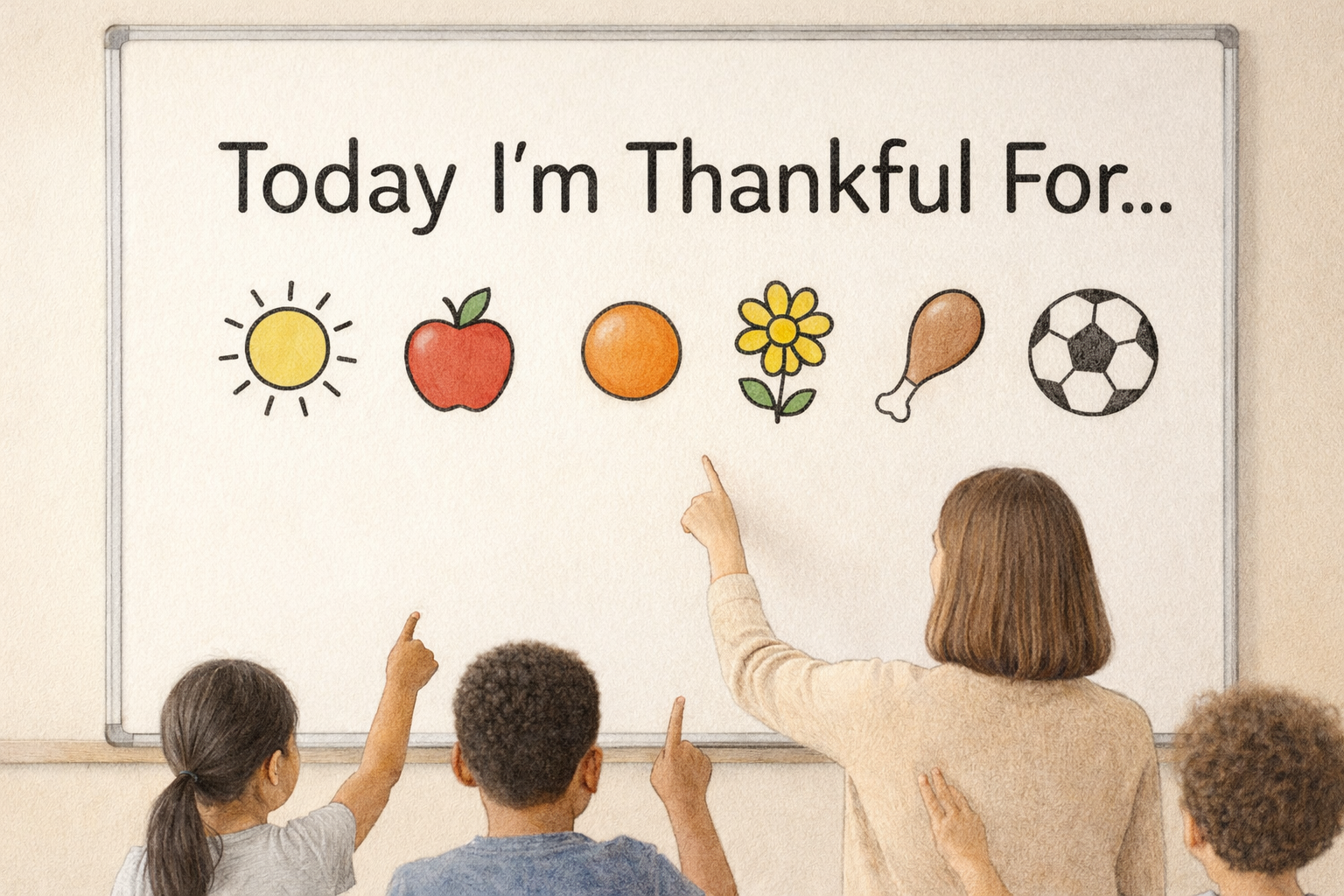
One day, he stopped by and watched our gratitude practice. He liked it so much that he tried it with his own students. His team modeled first:
- “Today I’m thankful for celery.”
- “I’m thankful for last night’s soccer game.”
Then, his assistants joined in. Finally, the kids had a chance to share—either with words or by circling a picture on the board.
Years later, when I visited his classroom again, I noticed he was still using the gratitude routine. He told me he believed it had radically decreased negative behaviors. He was sold!
A Lesson for Me, Too
Gratitude isn’t only for students. I promised my kids during the shutdown that I’d begin each day for a month with gratitude. Before getting out of bed, I’d pause and think of one new thing I was thankful for.
That month has stretched into years. I’m still practicing it daily. And you know what? I’ve found myself calmer, more at peace, and quicker to see joy in the ordinary.
Final Thought
Teaching my students about gratitude began as a classroom experiment. But it grew into a life lesson that continues to shape me today. Gratitude softens hearts, reduces stress, and builds connection—whether in a classroom or at home.
If you’re raising or teaching a child who struggles—whether with behavior, communication, or big emotions—gratitude may be one of the small steps that leads to a big difference. I’d love to come alongside you and share more practical strategies for creating peace and connection in your learning environment.
Homeschool Special Ed Consultant
Patty McCarty, LLC
971-515-9760
homeschoolspecialed.pm@gmail.com
Supporting home educators since 1995!