
A First Impression That Stays With You
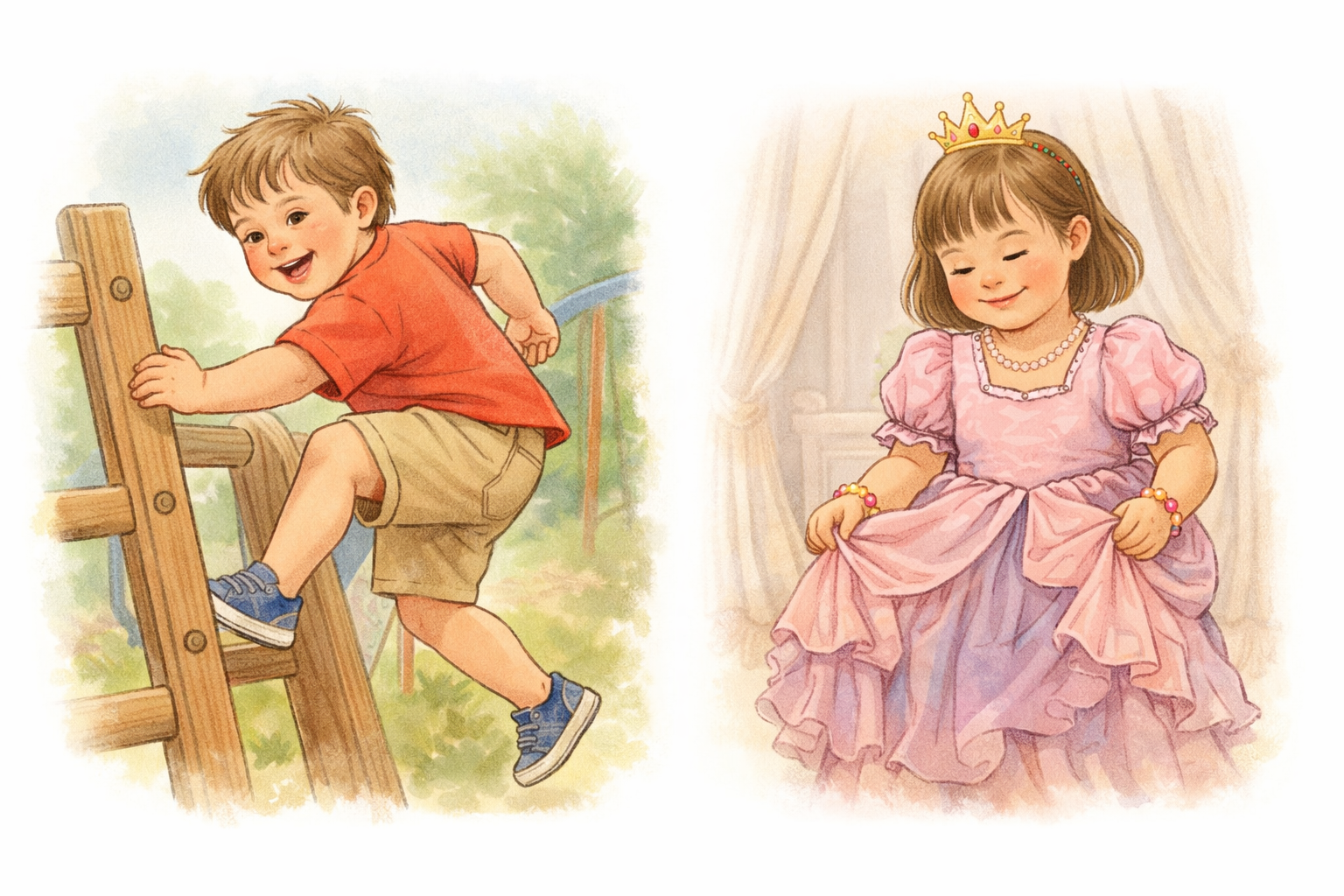
One of the most delightful students I ever worked with was a little boy I’ll call Abernathy.
I was 16, volunteering in a preschool classroom, and Abernathy quickly became unforgettable. He had been born with Down Syndrome and was expected to have significant developmental delays. And in some areas, that was true.
But not in the ways many people would assume.

Abernathy could run faster than most of the adults in the room.
He could catch and throw a ball.
He could move across monkey bars hand-over-hand—while still in preschool.
If he decided it was time to turn running into a game, I wasn’t catching him.
He was joyful, social, and deeply affectionate. He loved his parents, teachers, his classmates—everyone. At the same time, we were working hard on communication. At three years old, he had sounds, but not yet words.
Even then, it was clear: his development didn’t fit neatly into expectations.
A Very Different Kind of Strength
Around that same time, I worked as a volunteer in another setting with another three-year-old, Ivy—also with Down Syndrome.
But Ivy’s profile looked entirely different.

Ivy was the youngest in a highly educated, deeply attentive family. She had been given every possible opportunity for enrichment.
She loved pretend play. She organized games. She directed adults and peers alike—deciding who would stand where, and whose turn it was to speak.
She assumed, quite confidently, that she was everyone’s favorite.
And in many ways, she was.
Ivy was learning to communicate through sign language—“more,” “yes,” “no,” “toilet.” She wasn’t yet physically ready for full toilet training, but she could clearly express needs, preferences, and ideas.
Watching her, one thing became unmistakable:
A child does not need spoken language to communicate effectively.
What These Two Children Made Clear
It would be easy to group Abernathy and Ivy together based on a shared diagnosis.
But doing so would miss something essential.
Down Syndrome does not present as a single, predictable profile.
Instead, it spans a wide developmental range:
- Physical strength vs. physical delay
- Expressive language vs. nonverbal communication
- Social leadership vs. social participation
- Academic readiness at very different paces vs only ever learning self help skills or somewhere in between
What I saw in those classrooms—before I had formal training—was variability.
What I understand now, after years of working with students, is that variability is the rule, not the exception.

A “Re-frame” for Parents
If you are parenting a child with Down Syndrome, you have likely already encountered expectations—spoken or unspoken—about what your child will or will not be able to do.
Some of those expectations may feel limiting. Others may feel confusing when your child doesn’t match them.
Here is the important shift:
Your child is not a category. Your child is has a profile, but always, your child is an individual. And your specific child deserves to be understood—specifically, carefully, and without assumption.
What Actually Helps
Across students with similar diagnoses, a few principles consistently make a difference:
- Lean into strengths early
Physical, social, or cognitive—strengths are the entry point for growth. - Support communication in any form
Spoken language, sign language, gestures—all communication counts and should be built upon. - Watch the child in front of you—not just the diagnosis
Progress often shows up in unexpected areas and on unexpected timelines. - Align expectations with development, not labels
This reduces frustration—for both child and adult.
A Personal Note
As a teenager, I remember briefly wondering if children like Abernathy and Ivy were something more than human—something almost angelic in their warmth and openness.
But what stayed with me over time was something more grounded and more important:
They were fully human. Distinct. Complex. Capable of joy, mischief, growth, and resistance—just like every other child I have ever taught. I have since seen students with Down in a high school setting with cognitive capabilities from being fully on schedule with general ed peers to not being more than an infant at age 21 and a WIDE variety in between.
And they deserved to be understood as individuals.
If This Feels Familiar
If you are raising or supporting a child with Down Syndrome and find yourself wondering:
- What is realistic?
- What should we be working on?
- Why does my child seem so different from others with the same diagnosis?
You’re asking the right questions.
And you don’t have to answer them alone.
I have spent years working with students across a wide range of developmental profiles, helping families identify what is possible—and how to move toward it.
If that kind of support would be helpful to your family, I’d be glad to connect.
971-515-9760